Next-Gen Cloud Architecture: Designing Self-Healing Multi-Cloud Deployments with Terraform & AI
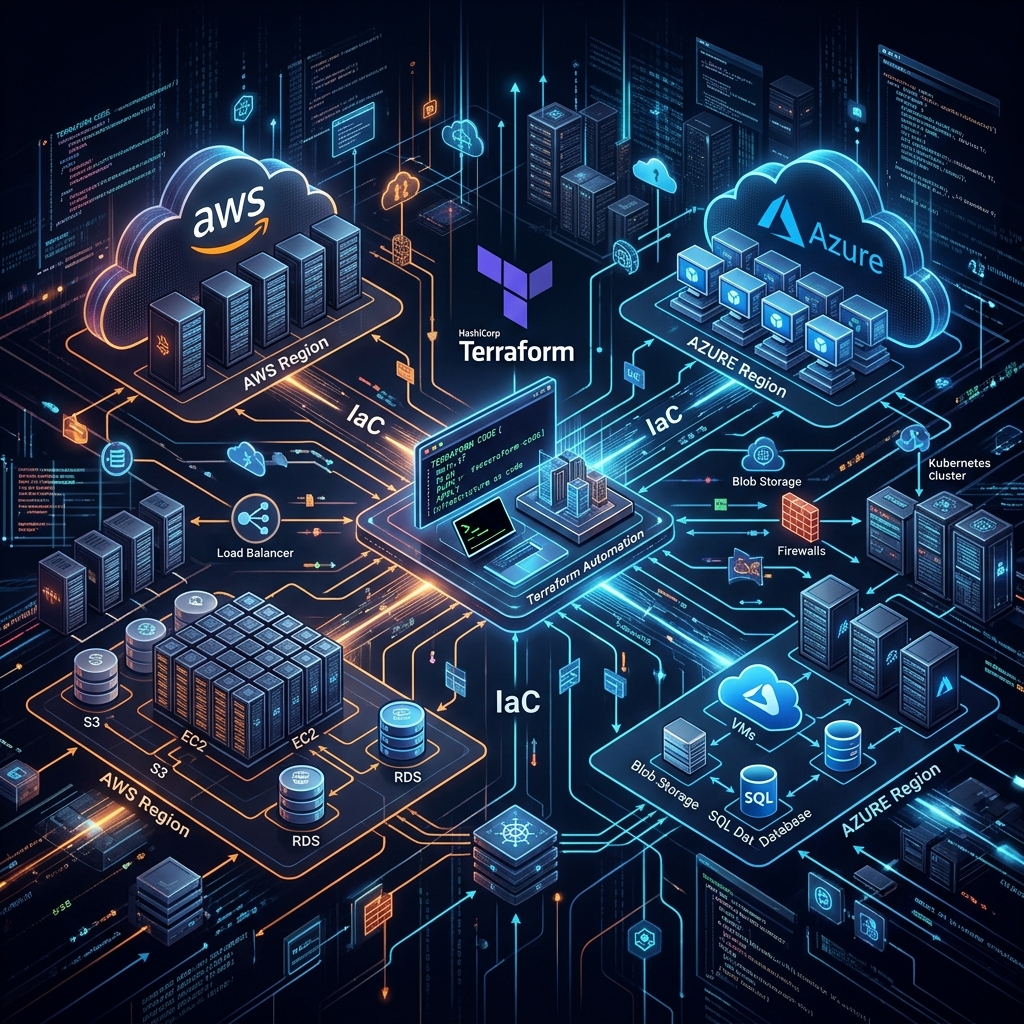
As businesses scale, the complexity of managing multi-cloud environments (e.g., bridging AWS, Microsoft Azure, and Google Cloud) introduces severe operational challenges. A single configuration error or localized outage can cascade into widespread downtime.
Traditionally, remediation meant setting up alert triggers that paged an on-call DevOps engineer, who would manually debug the issue, alter state, and run an Infrastructure as Code (IaC) deployment. Today, the convergence of Terraform and AI telemetry loops makes it possible to build entirely self-healing multi-cloud deployments.
The Foundations of Self-Healing Infrastructure
Self-healing systems don't just report anomalies; they resolve them. This design is built on three pillars:
- Infrastructure as Code (IaC) as the Source of Truth: Everything is declared in Terraform/OpenTofu configurations. Manual modifications ("drift") are strictly prohibited.
- AI-Driven Anomaly Detection: Observability engines (e.g., Datadog, Prometheus) process telemetry streams. AI models determine whether an alert represents a transient spike or a critical system degradation.
- Automated Execution Loops: Webhooks trigger automated pipelines (e.g., GitHub Actions, GitLab CI, or local runners) to modify Terraform variables and redeploy within minutes.
An Example Flow: Intelligent Multi-Cloud Failover
Imagine an enterprise application hosted on AWS with a warm standby deployment on Microsoft Azure:
Step-by-Step Remediation Scenario:
- Outage Detection: AWS US-East-1 experiences a major network routing outage. Traffic latency spikes by 400%.
- AI Telemetry Evaluation: The AI observability layer distinguishes this from a regular peak load, identifying it as an infrastructure outage.
- Variable Modification: The AI trigger initiates a GitHub Actions workflow, passing input arguments that modify the Terraform variable file:
active_region = "azure_westus". - Plan and Apply: The workflow runs
terraform planandterraform apply -auto-approve. Terraform dynamically updates the Cloudflare DNS record weights, shifting 100% of user traffic to the healthy Azure environment. - Drift Correction: Once AWS US-East-1 reports recovery for a continuous 15-minute window, the AI telemetry system triggers a safe failback sequence.
Best Practices for Terraform Self-Healing
To prevent automated loops from creating circular infrastructure failures or infinite loops, developers must follow strict safety patterns:
- Atomic Configurations: Keep Terraform modules small and decoupled. Never trigger self-healing on a massive, global monolithic state file.
- State Locking & Concurrency: Ensure remote state backends (like AWS S3 or Azure Blob Storage) have strict locking enabled to prevent concurrent automation runs from corrupting state files.
- Strict Rate-Limiting: Limit how frequently the AI system can apply changes. For instance, prevent more than one auto-apply within a 30-minute window to avoid cascading failures during a cloud provider outage.
Conclusion
The future of systems administration is autonomous. By building reliable feedback loops between real-time observability telemetry and Terraform IaC definitions, engineers can establish cloud architectures that protect themselves from downtime, lowering recovery times from hours to seconds.