The Best of Both Worlds: Why HTTP Finally Added the QUERY Method
For decades, API architects and web application developers have been forced into an awkward structural compromise when designing complex data searches. If your software needs to request data using multi-layered filters, dynamic sorting criteria, or high-volume parameters, the core HTTP protocol forces you to make a problematic design choice: misuse a GET request or cheat with a POST request.
In June 2026, the Internet Engineering Task Force (IETF) officially resolved this architectural constraint by publishing RFC 10008, introducing a brand-new, standardized HTTP method called QUERY.
This protocol update represents the most significant addition to core web semantics since PATCH gained global adoption. Let's break down exactly why it was created, how it addresses legacy workflow loopholes, and what it means for next-generation system engineering.
The Core Problem: The GET vs. POST Architectural Flaw
To understand why a new specification was mandatory, we must evaluate the design failures of the two methods developers traditionally relied upon to query backend databases.
The GET Limitations: Mile-Long URLs
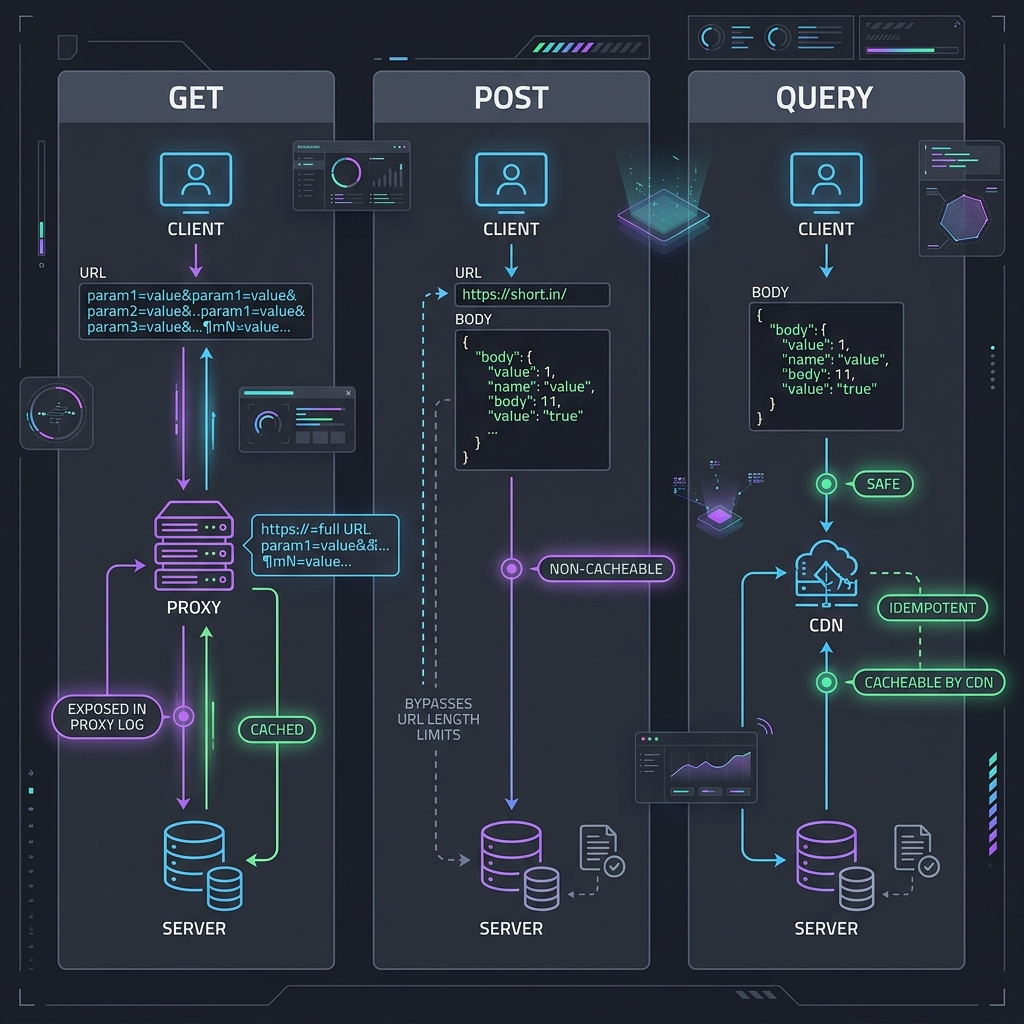
A standard GET request is designed to retrieve a resource safely and repeatedly. However, HTTP rules dictate that GET requests carry all their parameters directly within the target Uniform Resource Identifier (URI) query string. When an application implements advanced data sorting, complex enterprise dashboards, or deep AI-driven search operations, this pattern hits two critical roadblocks:
- Strict Size Thresholds: Most server routers, content delivery networks (CDNs), and intermediate proxies enforce a hard ceiling on URL lengths (typically around 8,000 characters). Blow past this limit, and the infrastructure drops your transaction.
- The Privacy Moat: Data embedded in a URL is fundamentally insecure. URLs are captured in plain text across proxy logs, server metrics, browser histories, and monitoring platforms, creating massive leaks for sensitive search variables.
The POST Workaround: Broken Semantics
To bypass URL limits, developers frequently route read-only data searches through POST requests, packaging their complex query parameters cleanly inside a structured JSON request body.
While this solves the size barrier, it violates standard web design principles. In HTTP semantics, POST is explicitly non-idempotent. It signals to the network that you are executing a state change on the server (such as creating a user or making a financial transaction). Because intermediaries cannot assume a POST request is read-only:
- Automatic Retries are Blocked: If a proxy drops a connection halfway through a
POSTsearch, it cannot safely resend the request automatically because doing so might trigger unintended duplicate actions. - Caching Utilities are Disabled: Edge caching and CDN clusters disable optimization caching on
POSTpipelines by default, forcing heavy computational loads back to your primary database servers.
Enter HTTP QUERY: The Complete Paradigm Shift
The newly standardized QUERY method combines the structural flexibility of a POST request body with the strict safety and predictability guarantees of a GET request.
QUERY /products/search HTTP/1.1
Host: api.example.com
Content-Type: application/json
Accept: application/json

{
  "category": "books",
  "price": { "lt": 30 },
  "sort": ["-published", "title"],
  "page": { "size": 20 }
}
The specification dictates that a QUERY request target processes the enclosed body content in an explicitly safe and idempotent manner. It does not alter server-side data state. Because the protocol guarantees that repeating the transaction is entirely safe, the entire internet routing layer can instantly handle it like a standard GET: edge proxies can optimize caching structures, and HTTP clients can safely auto-retry dropped network packets seamlessly.
Key Takeaways: Evaluating the Method Matrix
| Protocol Attribute | HTTP GET | HTTP POST | New HTTP QUERY |
|---|---|---|---|
| Safe (No Server Side Effects) | ✅ Yes | ❌ No | ✅ Yes |
| Idempotent (Safe to Auto-Retry) | ✅ Yes | ❌ No | ✅ Yes |
| Carries Structured Request Body | ❌ No defined meaning | ✅ Yes | ✅ Yes (Mandatory Content-Type) |
| Cacheable by Default Intermediaries | ✅ Yes | ❌ No | ✅ Yes |
- Content-Type Enforcement: The RFC specifies that
QUERYrequests must declare a distinctContent-Typeheader (e.g.,application/json,application/sql, orapplication/graphql). If it is missing or mismatched, the server rejects the request immediately. - Discovery Headers (
Accept-Query): Servers can now advertise exactly which query languages or filtering schemas they support by broadcasting a nativeAccept-Queryheader during preflight options checks. - The GraphQL & Vector Solution: Large query frameworks like GraphQL and high-volume vector search engines no longer require
POSTworkarounds. They can run large data filter footprints natively at the protocol level.
Conclusion: The Modern API Standard
The launch of the HTTP QUERY method under RFC 10008 officially irons out a structural compromise web developers have accepted for decades. By detaching a request's parameter footprint from the physical limits of a URL string without losing safe retry and edge-caching capabilities, the industry gains a highly scalable, semantic standard for read-only operations.
While browser ecosystems and client-side web frameworks are only beginning to roll out native client engine support for the method, server-to-server microservices and modern API networks are already adopting QUERY to construct cleaner, highly optimized automation architectures.