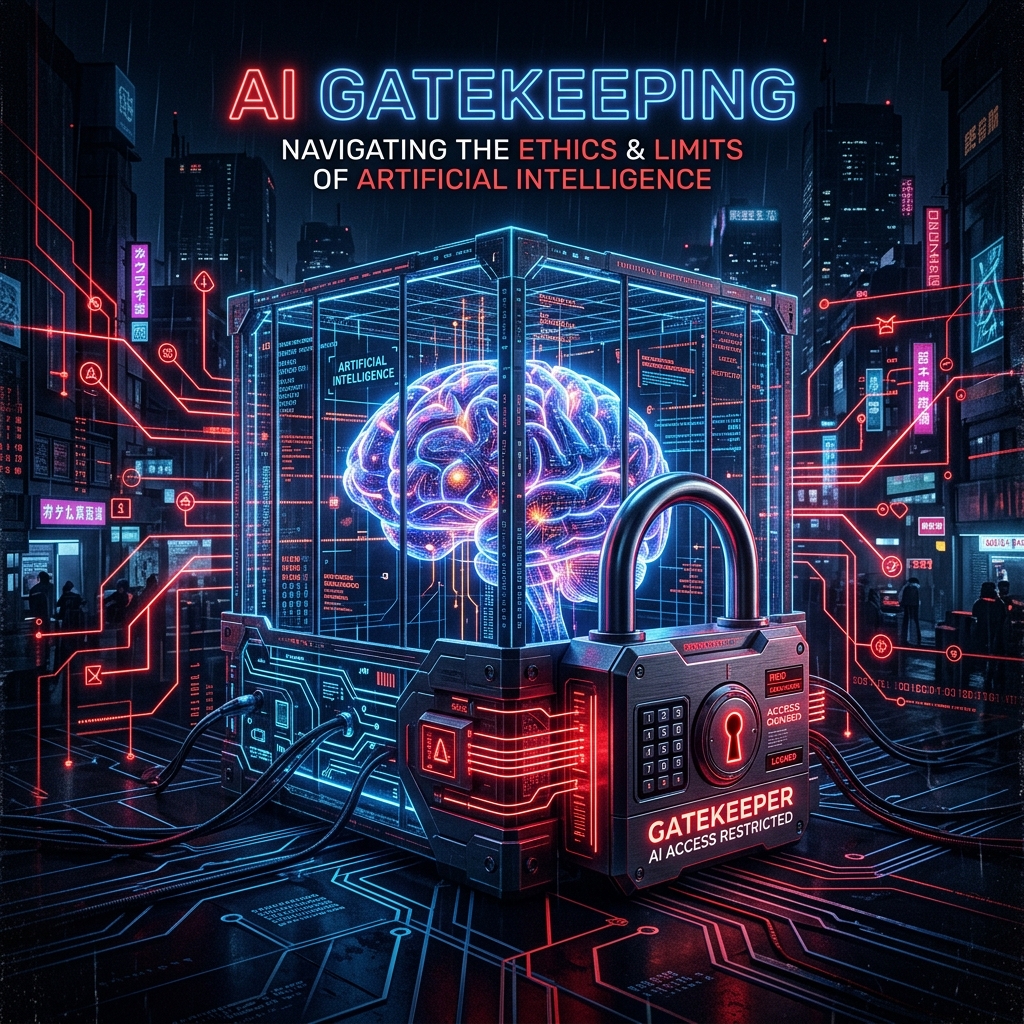
Gatekeeping AI: The Quiet Death of Open Intelligence
For years, the promise of the artificial intelligence boom was universal democratization. The narrative was simple: advanced tools would eventually be distributed to everyone, elevating human potential and leveling the technical playing field. Whether you were a lone developer in Pune, a startup founder, or a massive enterprise, the raw power of the next frontier model was supposed to be at your fingertips.
That promise just quietly died.
OpenAI has officially previewed its strongest, most capable model architecture to date: GPT-5.6 Sol. Alongside its smaller iterations—Terra (a highly efficient model with GPT-5.5 performance at half the cost) and **Luna** (OpenAI's fastest, lowest-cost engine)—Sol represents a major technological leap forward. In strict cybersecurity benchmarks, Sol consistently handles intricate tasks in a fraction of the time, outperforming competitor architectures with only a third of the effort.
But here is the catch that should concern all of us: you aren't allowed to use it.
The Limited Preview Bottleneck
Instead of an immediate public rollout or an accessible developer API tier, OpenAI is restricting access to GPT-5.6 Sol. At the explicit request of the U.S. government, the model is entering a strictly controlled, limited preview restricted to a select inner circle of trusted enterprise partners and federal agencies.
While the general public can leverage the scaled-down efficiency of Terra or Luna, the true core of elite machine intelligence remains gated behind corporate and regulatory walls.
GPT-5.6 Series Architecture & Access Tiers
GPT-5.6 Terra
GPT-5.5 capability at 50% cost. Balanced & efficient.
AvailableGPT-5.6 Sol
Elite reasoning, advanced logic, cyber benchmarks.
Gated PreviewGPT-5.6 Luna
High-volume automation, fast text extraction, ultra-low cost.
AvailableThis gatekeeping presents a distinct structural challenge to the open-source community:
- The Head-Start Monopolization: A handful of conglomerate organizations are gaining exclusive access to the most advanced logic models on Earth. By the time these models trickle down to standard developer APIs, these corporate incumbents will have already mapped out products, acquired market share, and locked down underlying pipelines.
- A Shift from Code to Regulatory Moats: The competitive barrier in AI is rapidly shifting from computational execution to regulatory approval.
Built on Public Data, Gated for Private Use
What makes this restriction particularly controversial is the foundational fuel that built the model in the first place. GPT-5.6 Sol wasn't trained in a vacuum; it was trained on the collective output of human digital culture. It absorbed our public repositories, our open-source code, our written articles, and the billions of daily text variables that humanity has placed on the internet over the last two decades.
Open Source Repositories
Public Git commits & libraries
Digital Culture & Articles
Human knowledge & discussions
Global Internet Telemetry
Publicly shared web data
GPT-5.6 Sol (Gated)
The model is trained on global public data, but access is restricted to a small select circle.
Restricted AccessThe data generated by individual developers, creators, and builders worldwide was used to train the model. Yet, the tech community is now being told that the general public cannot be fully trusted with the highest-performing iteration of that data.
Key Takeaways: The New Intelligence Divide
| Model Variant | Operational Focus | Accessibility Tier |
|---|---|---|
| GPT-5.6 Sol | Elite reasoning, advanced logic, cybersecurity benchmarks | Restricted (Gated Partners) |
| GPT-5.6 Terra | Balanced day-to-day tasks; GPT-5.5 level capabilities | General Availability (2x cheaper) |
| GPT-5.6 Luna | High-volume automation; fast text extraction | General Availability (Lowest cost) |
- The Intelligence Asymmetry: The digital economy is moving away from an economic divide based on money, shifting instead toward an asymmetry of access to intelligence itself.
- A Pivot in Enterprise Strategy: For lean engineering groups, this architecture makes relying purely on gated frontier models a major dependency risk. The value of open-source fine-tuning and localized orchestration has never been higher.
- The Importance of Local Autonomy: As top-tier models face tighter regulatory locks, developers must focus heavily on running highly efficient models locally on private hardware to protect project long-term independence.
Conclusion: The Case for Distributed Open Source
The limited rollout of GPT-5.6 Sol highlights a vital inflection point for next-generation software development. When elite intelligence is centralized and restricted, the broader engineering community must adapt.
The true defense against algorithmic gatekeeping isn't waiting for access clearance; it is accelerating our investment in highly optimized, localized open-source architectures. By prioritizing distributed system designs and local models, the open community ensures that technology remains an equalizing utility rather than an exclusive privilege.