
Day 4: Ditching the Data Traps — Mastering the Train-Test Split and Avoiding Data Leakage
Welcome to Day 4 of your 3-Month AI Engineer roadmap. Over the first three days, we locked down our local runtime environments, parsed data architectures using Pandas, and harvested unstructured code representations from the live web. Now, we are officially crossing the boundary line into Phase 2 (Week 3–4): Machine Learning Basics.
As an AI engineer, you will rarely be tasked with inventing a raw machine learning algorithm from a blank page. Instead, your primary engineering value lies in your ability to prepare features cleanly, prevent model corruption, and evaluate performance accurately. Today, we focus on the fundamental separation of concerns in machine learning: dividing our data matrix into training and testing subsets using Scikit-Learn while avoiding the silent, pipeline-destroying error known as Data Leakage.
1. The Separation of Concerns: Train-Test Mechanics
Evaluating a machine learning model on the exact same data variables it used during training is the most fundamental methodological mistake you can make. An algorithm can simply memorize every row it encounters, generating a flawless performance score while completely failing to generalize to new, unseen production inputs. This critical error is called Overfitting.
To establish an honest estimation of accuracy, your dataset must be split into two isolated blocks:
- The Train Dataset: The matrix array used to fit the internal coefficients and mathematical parameters of the model.
- The Test Dataset: A completely independent holdout subset used exclusively to audit the model's predictions against known target indicators.
Using Scikit-Learn’s train_test_split(), we pass our feature array ($X$) and label array ($y$), explicitly configuring the partition footprint (commonly an $80/20$ or $70/30$ percentage configuration).
from sklearn.model_selection import train_test_split

X_train, X_test, y_train, y_test = train_test_split(X, y, test_size=0.20, random_state=42)
The Professional Anchor: Always hardcode your random_state execution key. Because splitting relies on a pseudo-random number generator, setting a static seed ensures that your arrays partition identically across every test run, keeping your benchmarking trials completely reproducible.
2. The Silent Killer: Data Leakage in Preprocessing
You can write syntactically perfect Python code, achieve exceptional validation scores on your test set, and still deploy a broken model if your engineering pipeline suffers from Data Leakage. Data leakage occurs when information from outside the training dataset accidentally influences the model's training process.
The most frequent venue for this error is during data preprocessing steps, such as feature scaling (e.g., computing a column's mean or standard deviation to standardize data).
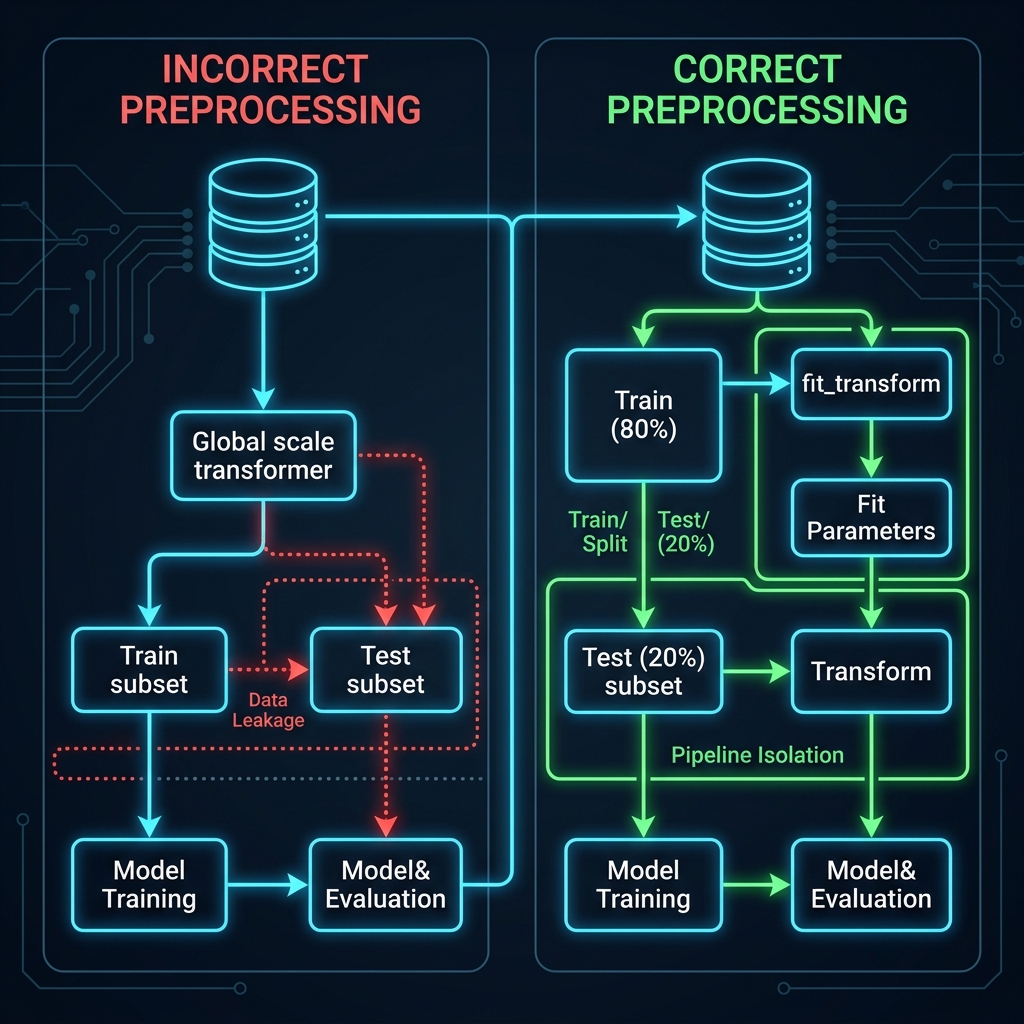
The Incorrect Anti-Pattern:
If you execute a feature transformation function across your entire unified database before calling train_test_split(), your training matrix absorbs structural calculations (like the global maximum value) that belong to the test set. Your model has unfairly "seen" the future.
The Correct Engineering Rule:
You must partition your data arrays first. Calculate all statistical parameters (means, scales, vocabularies) exclusively on the training subset by calling .fit_transform(). Then, apply those fixed, historical metrics to the test subset by calling .transform() only. Never call .fit() on your holdout data.
Core Task: The Leak-Proof Validation Script
To pass Day 4, you will construct a clean, leak-proof data preparation and model validation script inside your workspace.
Create a Python script using Scikit-Learn that executes the following lifecycle:
- Load an unstructured tabular dataset containing missing values and raw continuous numerical ranges.
- Immediately isolate the target vectors and partition the data into an $80%$ training and $20%$ testing split with a locked random seed.
- Compute missing value imputations and calculate scaling metrics exclusively on the training features.
- Apply the computed training transformations to the testing features without recalculating new metrics.
- Fit a baseline regression model on the clean training set, and log your successful matrix state changes using Git.
Key Takeaways for Day 4
| Implementation Target | The Safe Engineering Path | The Dangerous Trap |
|---|---|---|
| Data Partitioning | Hardcode a static random_state=42 seed |
Allowing dynamic random splits that break pipeline reproducibility |
| Feature Transformation | Run .fit_transform() only on training records |
Scaling the entire dataset uniformly before execution splitting |
| Model Verification | Audit model metrics exclusively using the holdout test set | Modifying model design hyperparameters based on test set scores |
Conclusion: Guarding the Validation Moat
Day 4 transitions your engineering perspective from basic coding to rigorous model evaluation. By mastering the execution mechanics of train-test partitioning and establishing leak-proof preprocessing pipelines, you ensure that your performance metrics represent true generalization capabilities. This defensive coding baseline is vital as we build advanced text categorizers and multi-agent systems later in the roadmap.