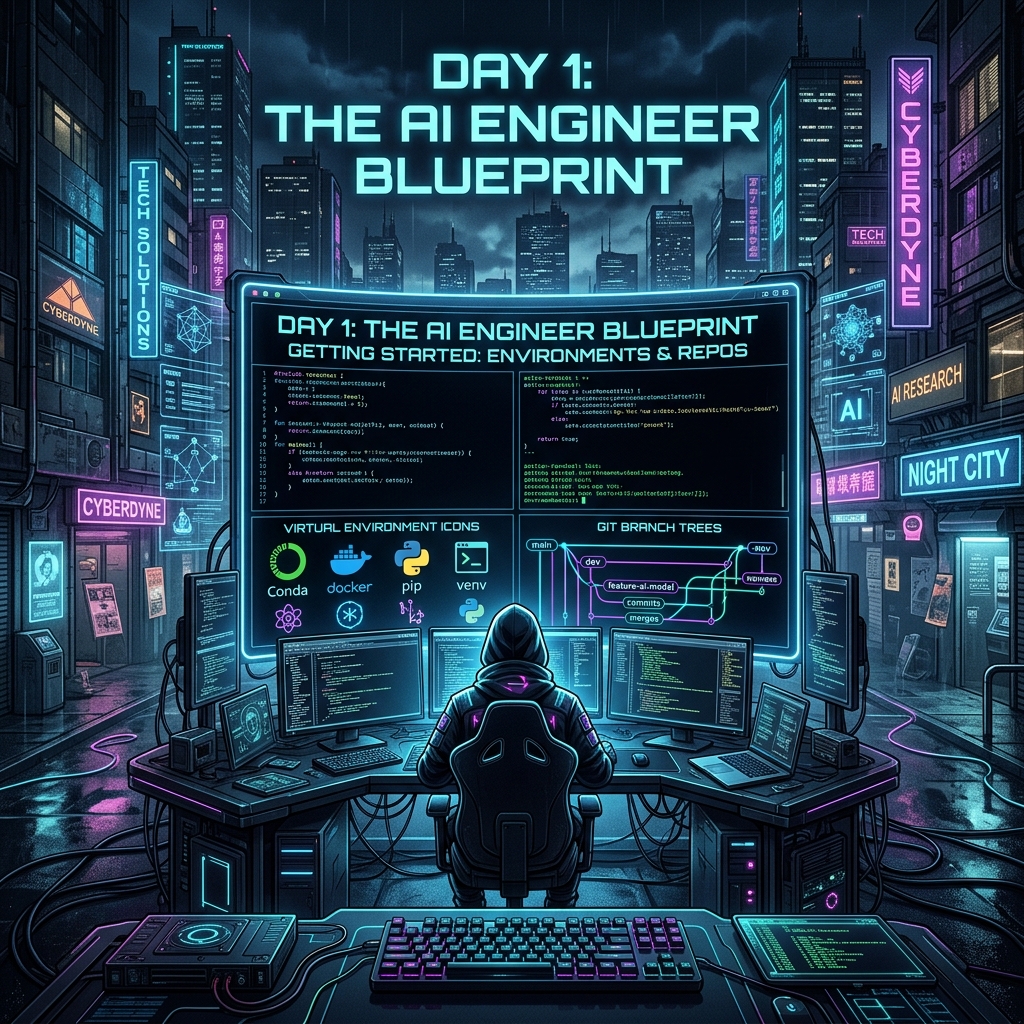
Day 1: The AI Engineer Blueprint — Ditching Syntax Obsession for System Thinking
The transition into artificial intelligence engineering is heavily misunderstood. The vast majority of aspiring professionals spend months memorizing complex algorithmic math or obsessing over syntax strings in Python. Yet, engineers inside top-tier environments will tell you a different story: the raw technical execution layer is being commoditized rapidly by agentic models. The true competitive moat belongs to the System Architect—the engineer who knows how to structure automation, move data efficiently, and bind multiple APIs into a resilient backend.
Welcome to Day 1 of your comprehensive 3-Month AI Engineer roadmap. We are kicking off Phase 1: Python + Data (Week 1–2) by focusing exclusively on programmatic foundations and setting up a professional developer ecosystem.
The Day 1 Focus: The Pragmatic Developer Stack
To build enterprise-grade AI systems, you must stop using basic sandbox scratchpads and move into an industry-standard local environment. Your goal today is to construct a resilient local pipeline capable of script isolation, automated dependency tracking, and seamless version routing.
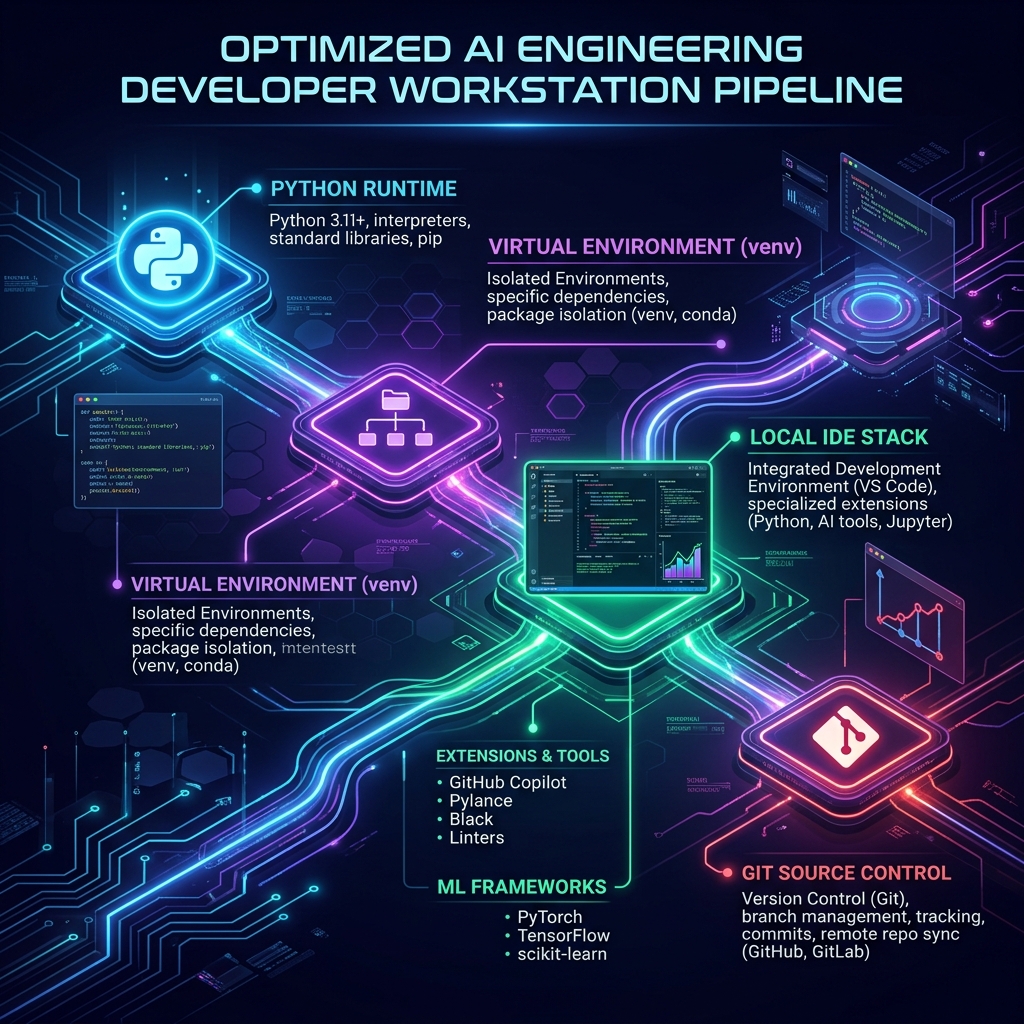
To achieve this, you will focus on four critical implementation pillars:
- Virtual Environments (
venv): Never install project dependencies globally. You must learn to isolate each project's package versions to prevent microservice collision. - The OS Module & File Systems: AI engines depend heavily on dynamic document processing. Your code must know how to programmatically navigate local file pathways, list document matrices, and automate system storage checks.
- Package Management (
pip): Master the clean orchestration of external libraries, package locking mechanisms, and the compilation of absolute tracking files (requirements.txt). - Source Control (Git): Establish clean repository version tracking, branching strategies, and commit hygiene from the very first script you run.
Core Task: Your First Automation Script
To pass Day 1, you will not write abstract math loops. Instead, you are going to code a functional utility script that replicates real-world data preprocessing.
Open your local IDE and write a Python script that accomplishes the following parameters autonomously:
- Initialize a clean local virtual environment and log the activation state.
- Programmatically scan a designated local directory for raw unstructured text files.
- Extract the text data, clean formatting anomalies, and compile a single structured inventory file.
- Execute full version control logging via Git to push the change baseline.
The Professional Standard: If you already have programming familiarity, do not waste a week rewriting basic loops. Focus explicitly on building highly scannable, modular functions, error-handling assertions, and implementation documentation.
Key Takeaways for Day 1
| Learning Pillar | Focus Action | Avoid This Mistake |
|---|---|---|
| System Isolation | Use venv for absolute project separation |
Installing python libraries globally across the OS |
| Data Automation | Leverage the os and sys modules for directory loops |
Hardcoding specific local file string paths |
| Version Hygiene | Execute atomic commits using transparent Git documentation | Coding massive projects without tracking file state |
- Syntax is a Commodity: The ability to write specific code lines is instantly accessible via LLM interfaces. Your value lies in understanding system logic and data flow.
- Production Readiness: A script that runs cleanly in a local sandbox but breaks during deployment due to unmapped dependencies is useless. Lock your environments down early.
- Automation Over Manual Tasks: The hallmark of an AI engineer is the reflex to automate file management, logging systems, and basic environment setup routines.
Conclusion: Setting the Baseline
Day 1 is about stripping away the hype and mastering the silent engineering execution that supports multi-agent systems. By constructing a secure, isolated local development workspace and commanding structural file manipulations, you lay the exact pipeline foundations required to manage large token context windows and dynamic vector indexing later in the roadmap.