Beyond Prompting: How Loop Engineering is Architecting the Next Era of AI Automation
For the past few years, the defining skill of the artificial intelligence boom has been prompt engineering. Professionals across every industry rushed to master the art of writing the perfect text instruction—treating large language models (LLMs) like highly capable, but ultimately reactive, search boxes. You ask a question, you get an answer, and the interaction stops.
But according to the builders on the absolute bleeding edge of technology, that era is already drawing to a close.
A fundamental shift is occurring as industry leaders transition from one-off prompting to Loop Engineering. This architectural evolution moves AI out of chat boxes and into continuous, self-correcting execution cycles. In fact, Boris Cherny, the creator of Claude Code at Anthropic, recently noted that he doesn't even prompt AI anymore; his entire workflow consists of writing loops and letting autonomous systems execute the work.
Deconstructing the 4-Stage Loop
What exactly is a loop? Unlike a standard query, a loop is a tiny, self-running program that operates autonomously on a schedule or trigger, infused with agent intelligence. It continuously moves through a highly structured 4-stage cycle:
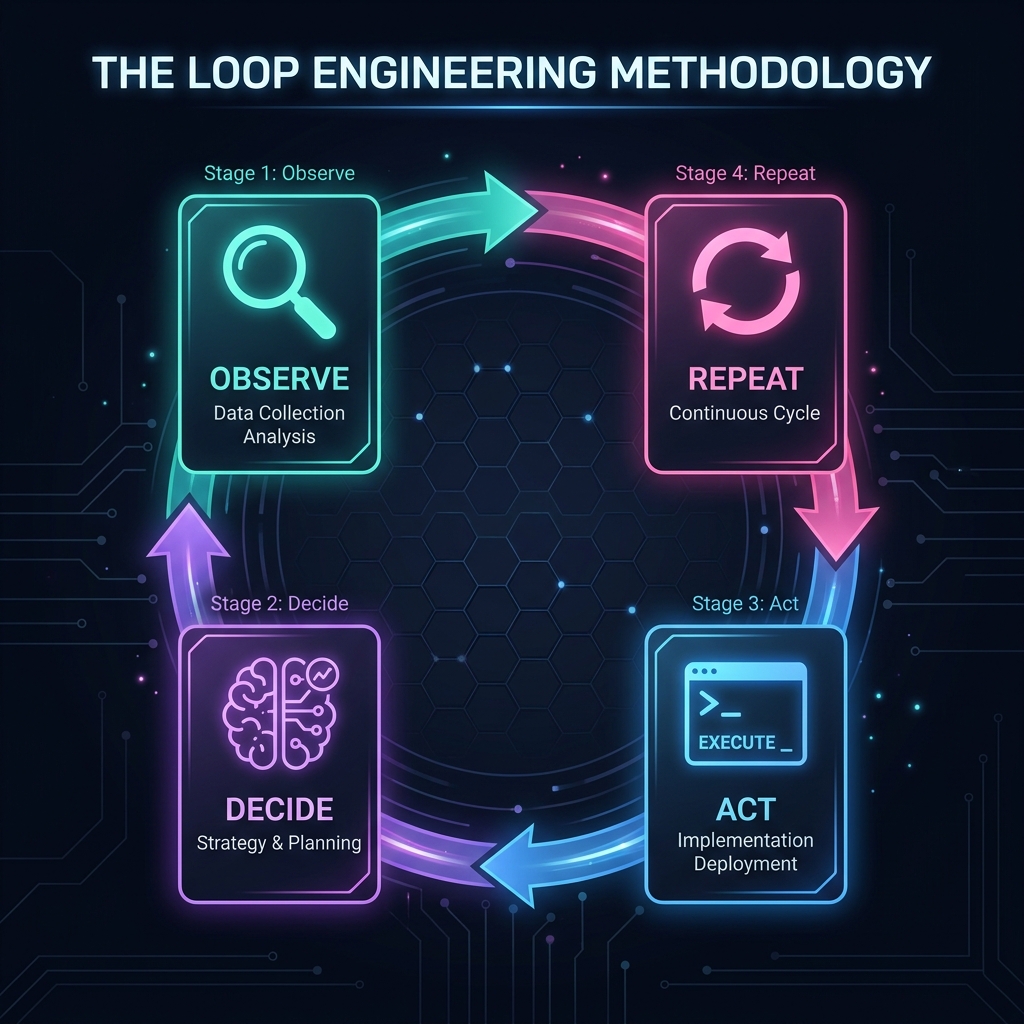
- Observe: The system automatically wakes up on a schedule (hourly, daily, or event-driven) and pulls fresh, real-world data.
- Decide: Using built-in reasoning models, the AI evaluates the context, identifies discrepancies, and judges what matters most.
- Act: The agent executes the next best logical action—such as writing code, updating record states, or routing information.
- Repeat: The program reruns the entire sequence from the top without requiring a human to type a new prompt.
In a traditional prompt workflow, you are the bottleneck. Every turn requires your input to keep going. With loop engineering, you simply define the desired end outcome once, and the AI works autonomously until that specific condition is met.
Orchestrating Master Loops and Data Fabric
Where this gets incredibly powerful is the integration layer. Instead of working in isolation, these loops connect natively to corporate data fabrics—pulling live info from CRM platforms (Salesforce, HubSpot), meeting transcripts (Zoom, Otter), and communication threads (Gmail, Outlook).
Furthermore, individual loops can be nested under a Master Loop. An engineering lead can establish a single master controller that orchestrates an entire department of sub-agents:
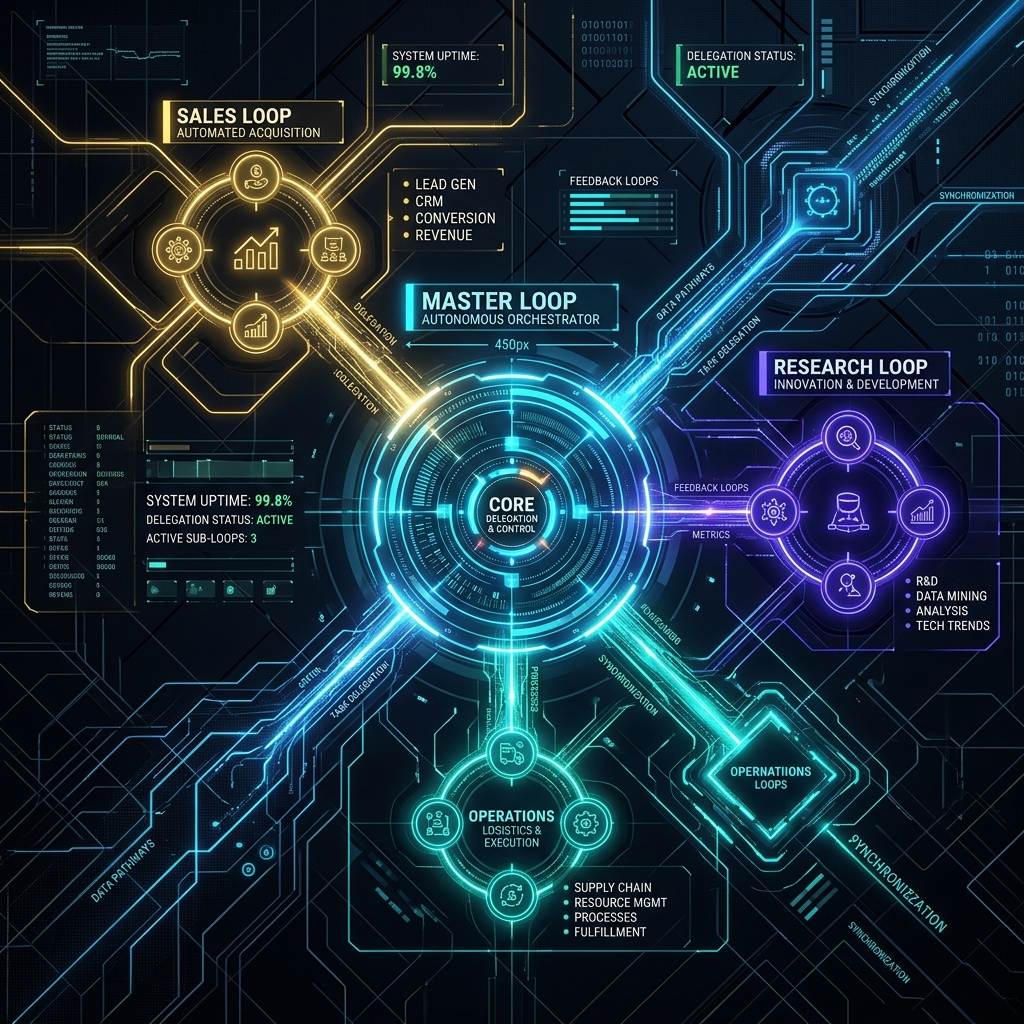
While you sleep, the Master Loop directs a Sales Loop to follow up on warm leads, prompts a Research Loop to monitor and summarize market movements, and commands an Ops Loop to keep system records and configurations thoroughly updated.
Built-in Enterprise Guardrails
Because these systems are entirely self-running, security cannot be an afterthought. Loop engineering implements hard operational guardrails so agents cannot go rogue. These include scope-limited actions, real-time audit logs, human-in-the-loop escalation layers for high-risk decisions, and an instantaneous infrastructure kill switch.
Key Takeaways: The Evolution of AI Maturity
| Evolution Stage | Interaction Model | Core Human Responsibility |
|---|---|---|
| Stage 1: Prompting | Ask once → get one answer | Micro-managing every turn; formatting inputs |
| Stage 2: Agents | Multistep reasoning execution | Triggering tasks and checking intermediate steps |
| Stage 3: Loops | Self-running, continuous systems | Architecting workflows and setting guardrails |
- Prompts Don't Vanish, They Nest: You still write prompts, but they are no longer interactive text strings typed into a web UI; they live nested deep inside the loop code as system instructions.
- True Asynchronous Automation: By decoupling human presence from AI execution, operations scale infinitely. The system handles data triage, evaluation, and resolution autonomously.
- The Rise of Workflow Architects: The most valuable software engineers and DevOps architects are shifting focus from writing specific code syntax to designing resilient, self-correcting agent execution loops.
Conclusion: Getting Ahead of the Curve
The transition from manual prompt building to loop engineering represents the true graduation of generative AI from a novelty assistant to production-grade automation infrastructure. As systems like Claude Code pave the way, the builders who stay ahead will be those who stop asking questions and start constructing loops.
Download the Loop Engineering Guide
Access the full PDF resource guide detailing how to build and orchestrate autonomous, self-running AI agent loops in your enterprise workspace.
Download PDF Guide